


New colourway "Fair Isle" on North Ronaldsay blend tops
Happy weekend everybody and welcome to another rare sheep breed adventure!
It was another super full on week here with loads of blending, carding and dyeing and spinning! New colourful wallaby batts, new lotus phangs and new hand dyed north Ronaldsay sheep blend tops in lots of new colourways!
The February clubs are all prepped and getting their colourful treatment and next week carding of all the club batts will begin. Shipping will happen later and I am super excited to show you teasers so keep your eyes peeled.
i have also signed up again for the absolutely fabulous handknitters guild of Victoria YARN SHOW at the Merribek (Coburg) town hall, Melbourne, planned on Saturday May 23rd and Sunday May 24th ! So please put it in your calendar to come visit us at our colourful super fluffy stall ! The next few months are going to be even more super SUPER busy for sure with new sock yarns, handspun and fabulous lace yarns as well !
Today's update is all about a very special rare breed sheep on the Scottish Isle of North Ronaldsay and there are loads of new colourways as well to feast your eyes on: Nevermore Valentine, Celtic Mist, Bad Bunny and more !
The North Ronaldsay Sheep are the only animals in the world, aside from a certain Galapagos lizard, to be able to subsist entirely on seaweed, leading to its nickname ‘seaweed sheep’. The breed is thought to be over 5000 years old. The breed is farmed within the Northern Ronaldsay Islands, Orkney and kept nearby the seashore for most of the year. In 1832 the Laird of North Ronaldsay decided that his pastureland should not be wasted on native sheep and a dyke was built round the island to keep them on the shore and off the land. It was most probably this separation that resulted in the preservation of the North Ronaldsay, as it prevented cross breeding which had been the downfall of other Orkney sheep.
The North Ronaldsay is one of the Northern Short tailed primitive group of breeds that also includes the Manx Loghtan, Soay, Shetland and Icelandic . The North Ronaldsay is still mainly found on its native island, the northernmost of the Orkneys. The sheep keeping system on North Ronaldsay is unique and involves a stone wall which keeps the sheep on the seashore and away from the cultivated land for most of the year. This wall was built in 1832 and since then the breed has evolved to survive primarily on seaweed. The sheep live on the seashore most of the year around and are only brought onto the better land for lambing.
The North Ronaldsay is one of group of primitive Northern Short-tailed sheep and represents a very early stage in the evolution of domestic sheep. DNA studies have shown a close relationship to sheep found in the Stone Age village of Skara Brae on mainland Orkney, which dates from 3000 BC. In 1832 a wall was built around their native island to confine the animals to the foreshore for most of the year in order to conserve the inland grazing. Since then the breed has developed its distinctive metabolism due to its diet of seaweed, which also renders it susceptible to copper poisoning under standard sheep management systems. North Ronaldsays are very sensitive to copper and will die of copper toxicity if put on the wrong type of grazing. This is due to their seaweed diet and the unique metabolism they have evolved. They should not be fed commercial sheep mixes as despite the label saying “No Added Copper” the normal ingredients used will often have a background level high enough to be toxic (ten parts per million is too high). The North Ronaldsay is capable of surviving on less than larger breeds and is an active browser, used to ranging over long distances in search of food.
Colours of their fleece are variable: including white, various shades of grey, black and moorit (deep brown). The double fleece has coarse outer guard hairs and a fine soft inner coat. I have never ever felt and dyed something as extraordinary as this sheeps fleece. It is springy, almost feels moist even after its scouring and washing. It almost feels like it resists the dye when you pour the pigments on and everything immediately flows to the bottom, leaving the top layer of the fibre springy and almost without dye. At least, that is what appears to happen…it takes the dye beautifully and retains its springy texture and openness.
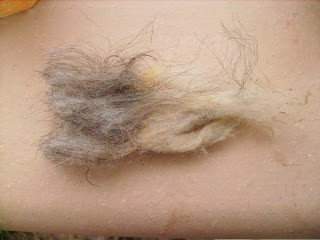
Before dyeing and spinning though was the rather painful process of getting rid of the guardhairs ! Here’s a view of the raw fleece :
After all of the cleaning and carding and blending you get what I am offering you today !
It is a dream to spin and work with. You can make a yarn that is strong and still soft to wear. It is very very special ! There are only about 600 of these seaweed sheep left in the world. Only through our effort of conservation of the environment and conservation through appreciation of this rare breed by spinning and knitting its fleece, can we hold on to one of the oldest and most special breeds in the world alive today.
You can check everything out in the what's new section on the IxCHeL shop by clicking here.
Have a fantastic weekend filled with lots of creative fibre fun !
Big hugs,
Charly